Wednesday, February 8, 2012

News Article


Wuhan Uprising
By Rachel Quinlivan

WUHAN- After much tension between The Million Heroes and The Wuhan Worker’s General Headquarters in Wuhan, China, the two groups broke out fighting on July 20th, 1968. After losing the authority of The Party Committee, there was no one to rule Wuhan, so military power took over. But the Cultural Revolution Authority thought this a plot to overpower them and encouraged people to fight the military power. This divided the people of Wuhan into two groups: “The Million Heroes” who supported the military power and “The Wuhan Worker’s General Headquarters” who supported the overpowering of the military power and the Cultural Revolution Authority.

Tension between the military and the people has been going on for a while. Many think that the military power is going against what the Cultural Revolution stands for. Factories and organizations stopped working and many people’s work has been put on hold. On July 20th The Million Heroes took a past official of Wuhan and criticized him in public. Several thousand people criticized the Cultural Revolution Authority while marching in the city. One marcher who did not want to be named said, “The Cultural Revolution Authority is wrong! The military power is doing a great job ruling! In the short time they have been here, my life has improved drastically. I don’t know why anyone would want to go against them...”

But not everyone feels this way. Some think the military power is ruining all of the progress that the Cultural Revolution is making. One rebel, Jianguo-Geming, said, “The military power here in Wuhan is stopping the progress that the Cultural Revolution is making for China. Everything was going great until they came. Since then all of the factories have shut down and I am out of work! There is no way for me to put food on my table and provide for my children! Can’t they just leave and let China become the great country we know it can be?”

Others do not have a say either way. Many of the elderly and children sit at home doing daily chores like cleaning and cooking. When asked about this fighting and what she thought, Huian-Meirong said, “I have no thought. Even if I did, there would be nothing I could do about it. I am an old woman whose duty is to keep the house clean and cook meals for my children and grandchildren. Do you expect me to go out there? And fight with those savage men? No, no, I think not. I will stay home and do my duty....”

Editorial


Military Finally Takes Over In Wuhan
By Rachel Quinlivan
            After years of the disastrous Cultural Revolution leaving disastrous effects on the people of China, someone has finally stepped up to overthrow the Red Guards. The Red Guards are the police of the Cultural Revolution- except worse. They follow Mao Zedong ruthlessly and will do whatever they can to make people do what he says. But many times, they go too far. The Red Guards will beat anyone who so much as looks at them the wrong way. What China needs is a stable government to keep peace and let China rise up in the world gradually. That is what the military is trying to do in Wuhan. The military is making the right choice. They are doing what is right for the people.
           
            The Cultural Revolution has ruined many people’s lives. It is forcing children to choose between their parents and the government- an impossible choice. They punish people for being born into a bad family, but it is not their fault. The military is doing their best to return peace to Wuhan. They do not care if you are rich or poor. As long as your intentions are good, you will be respected and have a good life. The military do not believe you should be respected just because you were born into a poor family. You must earn the respect. They also believe that everyone has something to give to China. Just because you are the great-great-grandson of a property owner, it does not mean you are worthless.
           
            Although Mao Zedong has the right idea, he is not going about it in the right way. People are dying left and right, and countless are being tortured. Citizens of China are expected to do what authority says without question, like sheep. But people should be able to express their opinions on what they think is right. They are trying to help China. Also, the idea of Communism is not quite right. Yes, it would be unfair if two people work the same amount and one is paid better than the other is. But what if one person just sits around home all day doing nothing while someone else works hard to make their life and their country better, and they earn the same amount of money? Would that be fair? No!
           
            China should stop trying to force Communism on its citizens. It is a bad idea that few people can benefit from. Right now, China should be focusing on restoring order and rising up in the world. Not focusing on who are better, poor people or rich people. It is time for China to become the best! But they won't be able to do that if people are constantly fighting.

Map


The Cultural Revolution era borders (1966-1976) are the same as modern day China borders. The modern day China borders are the dotted lines and the Qing dynasty borders is the orange-brown. The Qing dynasty was the dynasty previous to the Cultural Revolution. During the Qin dynasty, there was no Mongolia. China owned that land. Modern-day China is bordered on the north by Mongolia and on the west by many different countries. To the east is the East China Sea and south of China are many countries including India, Nepal, and Vietnam. Mt. Everest is on the border of China and Nepal. The capital of China, Beijing, is on this map as well.

Interview with Jiang Qing


Q: What was your life like before you met Mao Zedong? Is it better or worse?


A: I was born in 1914 and my father was a carpenter. I went to Qingdao University to become an actress, but when I tried to make a career out of it, it did not work as well as I had hoped. I had many failed marriages as well before I met Mao. I wouldn’t say that I had a bad life before Mao, but I feel more fulfilled. I am doing more work to help my country become a better place.


Q: What have you been doing to help China?


A: I am working on reforming the Beijing Opera so that they support Mao Zedong, control the art portion of China, and I advise my husband on political problems too. I accompany Mao to all important political events and I participate in them too. I have modeled a village, called Xiaojinzhuang, where they focus more on the arts than production in the political world. I feel that if all of China were like that then China could become very successful.


Q: What do you think of the way Mao is trying to achieve his goal?


A: I have no problem with it. As long as he is getting the job done, it is fine with me. Maybe he
is being a little violent, but if that’s what it takes to make China better, then that is what he will do. It is not easy to change China, and doing it peacefully would take years. China doesn’t have years. We need to act now! And if doing it violently is the way to do it, then that is how we will do it.


Q: You are saying “we”. Who is “we”?


A: All of China of course! Every citizen must participate in the Revolution so that it will be done successfully. Some people think of myself and Mao Zedong when I say “we”, and others think of Weng Hongwen, Zhang Chunqiao, Yao Wenyuan, and myself when I say “we”. I don’t know why people group the four of us together. It is an odd grouping, if I say so myself.


Q: Thank you for your time. Long live Mao Zedong!

A: I hope so...his health seems to be failing. I am worried about what will happen when he dies. I hope that China will be stable before that happens. If he dies while chaos is going on who knows what will happen? So yes, long live Mao Zedong!

Art and Music


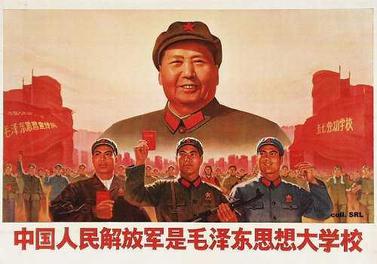
        The Cultural Revolution changed art greatly from past dynasties. All art was made to support the Cultural Revolution and Chairman Mao Zedong. Revolutionary heroes such as Red Guards and farmers replaced usual subjects such as birds, landscapes, and flowers. Oil paint replaced ink for paintings. Ink painting had been the most respected form of painting before the Cultural Revolution. During the Cultural Revolution, artists that used ink were tortured and publicly humiliated. Paintings that supported Mao were turned into posters and used as propaganda. The posters were hung everywhere in China- schools, stores, workplaces, even on walls in alleys and streets.
   
          Plays were also used to support Mao Zedong. Mao’s wife Jiang Qing controlled productions during the CR. She wrote eight operas and attendance to those operas were mandatory. The main characters in these operas were revolutionary heroes. One of the operas was called “The Red Woman’s Army”. It was about women fighting for a better, equal China.


This is a poster advertising an opera during
the Cultural Revolution. Notice the woman's
body position and what she is holding.
 

"A Day In the Life" Journal


“A Day In the Life” Journal
By Rachel Quinlivan

    I awoke to the sounds of banging in the house next to my host family’s. Another house search, another day, another person taken away for re-education. After two weeks, I am no longer fazed by it. It is part of everyday life. Everyone is being accused of being counter-revolutionary, of being a capitalist. I had to lie and say I supported Communists and the Cultural Revolution. If they found out who I really was, I could be arrested and beaten, even killed. I walked into the kitchen of my host family’s house. It was very plain, nothing fancy. Practical. My host mother, Chen-Lifen, was chopping vegetables for dinner tonight. Her clothes were plain as well. In fact, the whole family’s clothes were simple. It was considered “four olds” to wear makeup and fancy clothes. It was considered four olds to have a fancy house too.

  
       My host family was very supportive of the Cultural Revolution. Chen-Lifen was the neighborhood's party director. She knew every one's social status, and of course hers was the best. The whole family was at home sitting on simple wooden chairs. The youngest child was playing with handmade toys and the older one was writing da zi bao about their teachers and counter revolutionary people in the neighborhood. Two other children were in the countryside, working on the farms. The oldest son was a Red Guard and he was very proud of what he did. All day he walked around, looking for four olds. All of the schools were closed so the kids were home every day. Gang-Jiang, my host father was also out of work because the factory that he worked in closed. I heard that many factories had closed because they did not have enough workers.

        The neighborhood bell rang outside. It was time to go outside and sing about Chairman Mao Zedong. The way everyone worshipped Mao you would think he was God. Everyone had their own red book filled with quotes from Chairman Mao. It was crazy! Everyone crowded in the small alleyway. I noticed that there was a new painting on the wall at the end of the alley. It showed a man who was smiling, holding one of the Little Red Books. There were people behind him, smiling and holding red books as well. All around China were these posters, signs, paintings, supporting Mao and the Cultural Revolution. Every song and poem was written about Mao. Everything was Mao, Mao, Mao. I wonder if they dream about Mao Zedong too. I’m going home in three days and honestly, I can’t wait. I think I am being brainwashed. I can’t wait to go back home to America where everything is normal.

Tuesday, February 7, 2012

Bibliography

    Works Cited